Dr. Gymbro
←

#postmenopausal women

1 article
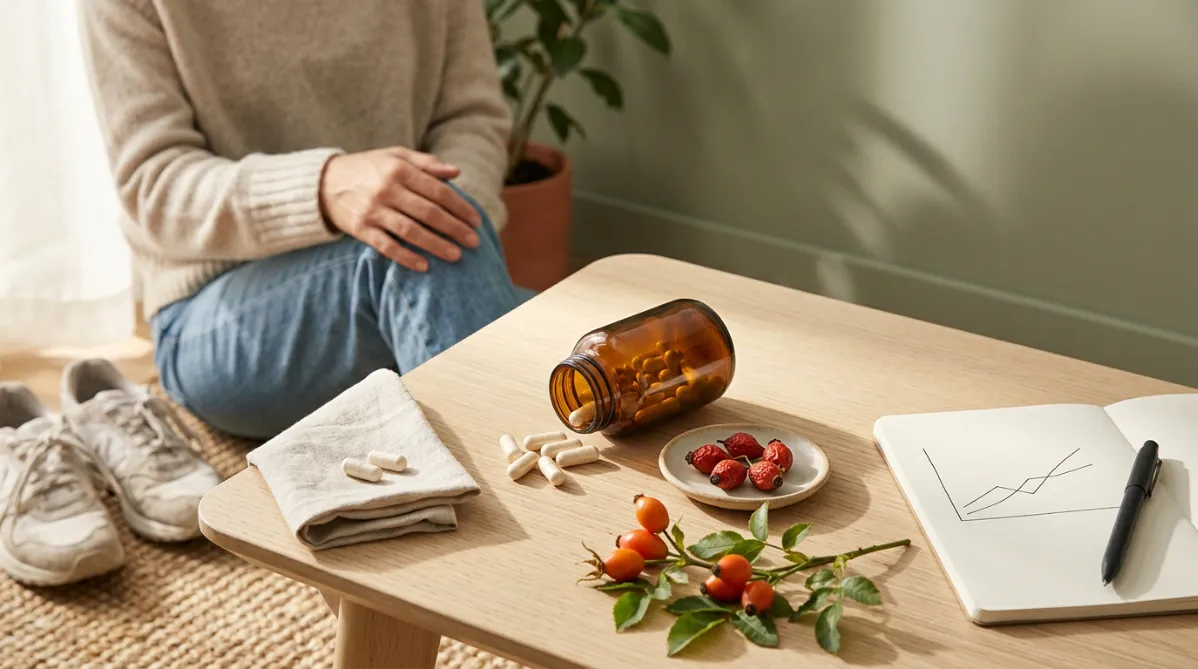
A softly lit editorial still life on a pale oak table, shot from a slightly elevated three-quarter angle in a wide landscape frame. In the center sits an open amber glass supplement bottle on its side, with a small scatter of cream-colored capsules spilling onto the wood. Next to it is a ceramic dish holding a few dried rosehips in deep coral red, and a sprig of fresh rosehip with glossy orange-red berries and green leaves lies across the foreground. On the left, a neat pair of matching white capsules rests on a folded linen napkin, a quiet visual nod to the placebo and treatment groups. Behind them, slightly out of focus, a woman's hands in a soft oatmeal knit sweater rest on a knee in relaxed denim, suggesting everyday movement without showing a face. A pair of worn, clean running shoes sits at the edge of the frame on a woven jute rug. On the right side of the table, a minimalist notebook lies open with a hand-drawn simple line graph, two gently rising lines nearly overlapping, next to a matte black pen. Morning window light streams from the left, casting long, soft shadows and a warm golden glow with gentle highlights on the glass bottle. The background is a muted sage-green wall with a hint of a leafy plant in a terracotta pot, creamy bokeh throughout. The palette is earthy and calm: warm beige, sage, terracotta, coral red, and soft white. The mood is thoughtful, trustworthy, and quietly skeptical, like a modern health and science journal. Clean composition with generous negative space on the upper right for headline overlay. Fine-grain film texture, shallow depth of field, natural color grading, high-end lifestyle magazine photography.
nutrition

Le supplément pour les genoux qui n’a pas atteint son objectif mais a tout de même attiré l’attention

BY DR. GYMBRO ·

Un essai randomisé a évalué un supplément à base de cartilage de poulet hydrolysé et de cynorrhodon chez 138 adultes actifs souffrant de douleurs au genou. Le critère principal n’a pas été atteint. Les deux groupes, supplément et placebo, ont tous deux amélioré de plus de deux points sur une échelle de 10. Les analyses exploratoires laissent entrevoir un bénéfice sur la douleur lors des activités quotidiennes, surtout chez les femmes post‑ménopausées, mais ces signaux proviennent de petits sous‑groupes et ne sont pas concluants. L’étude a été rédigée par des employés des entreprises derrière le produit. Voici ce que les données montrent, ce qu’elles n’ont pas montré, et comment envisager son usage.

This page is available in